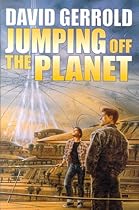
From Publishers WeeklyNebula- and Hugo-winner Gerrold, who scripted the classic Star Trek episode "The Trouble with Tribbles," gives an engaging new twist to the "growing up novel"--growing right off the planet Earth. Costarring with Gerrold's precocious 13-year-old hero, Charles "Chigger" Dingillian, is the Beanstalk, a dizzying orbital elevator system running on magnetic induction that lifts humanity from the exhausted Earth it is devouring to the Moon, the planets and, eventually, the stars. In this first volume of the projected Starsiders Trilogy, Chigger, the always overlooked middle sibling and neither child nor adult, is the human battleground for his divorced parents: a wimpy musician father who kidnaps his boys to give them a chance at a better life off Earth and a newly lesbian mother who venomously chases them into space. Chigger bridges the gap separating his older brother, Weird, and his younger, Stinky, as they ride the Beanstalk between the festering Earth, teeming with crazies and plagues, and the burgeoning new off-world societies. With the boys caught up in the smuggling and big-business intrigue that simmers in a world where international corporatism has made all borders irrelevant, Gerrold pulls off Chigger's choices with just the right mix of preteen braggadocio and heartbreak. The science here is every bit as convincing as the fiction, adding a satisfying intellectual dimension to the start of a classy take on an old, old tale: an everyboy climbs a beanstalk to discover who he will be as a man. (Mar.) Copyright 2000 Reed Business Information, Inc.From BooklistTwenty-first-century Earth is desperately overcrowded, and Charles Dingillian's father offers his three sons a trip to the moon. Actually, he is kidnapping the boys from their mother--and couriering key data in an illegal financial transaction. He is also a wimp, Charles' mother is bisexual, and Charles' older brother is gay. Oh--and the younger one is an obnoxious brat. Clearly we're not in Heinlein's Kansas. But cut through all the characterization-by-dysfunctionality, and a genuinely powerful coming-of-age story remains, with characters as sympathetic as they are bizarre and a vividly depicted future society. The legal scenes are worthy of Heinlein, and Gerrold's depiction of the giant space elevator, the Beanstalk, vividly fills in its technological details, its appearance, the life aboard it, the society of its permanent residents, and its potential for disaster. The first book of the Starsiders Trilogy suggests that Gerrold is obliquely approaching the territory of Heinlein's juveniles. Like much of Gerrold's work, this is sometimes over-the-top but always recognizably the creation of a major talent. Roland Green "Worthy of Heinlein. The creation of a major talent."--Booklist"Classy. The science here is every bit as convincing as the fiction." -Publishers Weekly"Through the perceptions of his youthful narrator, Gerrold portrays a near-future beset with problems that demand new solutions." -Library Journal can i get books for free Jumping Off The Planet (Starsiders Trilogy)
4 of 8 people found the following review helpful. Disappointing pastiche of HeinleinBy Gary M. GreenbaumIn this novel of a disfunctional family which evacuates a deteriorating Earth, Gerrold begins by writing as if it was a Heinlein juvenile--indeed, Charles, the hero, has been widely compared to the Heinlein juvenile hero. Interesting concepts (such as Gerrold's particular Beanstalk concept) are mixed with science lessons (the physics of same) in a classic Heinlein manner, though the first third of the books. But as the novel slows and approaches an end, Gerrold appears to move to Heinlein as of the '70s and '80s--the sort of novels with a few "good guys" whom you'd better like through thick or thin, and a bunch of "yammerheads". The example of this is Howard the Lawyer, a singularly unsuccessful lawyer with all sorts of unfortunate attributes who we get to laugh at (Gerrold makes it really, really, clear that he hates lawyers in all three books of this series). For some reason, this worthless lawyer, who couldn't win a case if he tried, is hired to represent the interests of multitrillion dollar corporations. But plot shouldn't get in the way of Gerrold getting us to share his petty hates. All is made right through a judge who will only enforce the rules against one side--which is very much a Heinleinian thing to do, but it is not a good lesson for kids. But as we are supposedly rooting for Charles and friends, it may not bother you much.I'm not going to bother to write reviews for books 2 and 3, but book 2 is a combination of The Moon is a Harsh Mistress and Have Space Suit--Will Travel--which does little credit to either. Book 3 combines the flashback "high school class" scenes of Starship Troopers with Gerrold's attempt to get to the conclusion on his own. It sort of trickles out for no apparent reason except that there are no more pages.Gerrold always has good ideas. But this time, good ideas just weren't good enough.1 of 3 people found the following review helpful. Masterful GerroldBy Donald A. PflasterEver since I read "The Man Who Folded Himself," I've been hooked on Gerrold. He's a fantastic sci-fi author who makes his proposed technological/futuristic ideas so incredibly real by superimposing the psychological effects of them onto real and profoundly deep characters. This allows the reader to believe that the events in his story have not only come to pass, but are in a constant state of flourishing growth -- be it Chtorran life forms or the great society of the Beanstalk as vividly described in this novel. He makes us *feel* science fiction.Kudos to Gerrold for his wisdom, vision, and heart.2 of 7 people found the following review helpful. There's no Jack in this BeanstalkBy Patrick ShepherdBack in the fifties Robert Heinlein pretty much perfected the science fiction 'juvenile' (which merely means that his protagonists were normally adolescents - not that the novels do not deal with difficult, complex, 'adult' themes and ideas). Few authors have had the temerity to write works that use the Heinlein model as their basis, but Gerrold has attempted it here.As a starting point, Gerrold takes a very dysfunctional family consisting of three brothers, all of whom have various highly anti-social character traits, and their divorced parents, who are constantly squabbling over custody and visitation rights to their children. He places them in a reasonably near-term future, where the multi-national corporations have pretty much taken over, 17 billion people are voraciously consuming what little resources planet Earth still has, and the defining technological development is the 'beanstalk', a massive wire hung from geosynchronous orbit all the way down to the planet surface and extending upwards nearly as far for balance. The father, at the end of his wits and finances, decides to 'kidnap' his children and take them up the 'beanstalk' as the first part of a journey to the moon and beyond in an attempt to leave his troubles (and legal jurisdiction) behind.The story is told from the viewpoint of the middle 13 year old brother, who feels 'left out', that his parents and brothers never really talk to him or deliver on their promises, leaving him cynical and withdrawn. As the story progresses, he begins to develop his own sense of responsibility for his actions and depend less on the 'that's not fair' type argument. Unfortunately, most of this development is somewhat hidden from the reader till near the very end of the book, where the statements he makes seem to almost come from nowhere, as too little of his underlying thinking has been previously shown. Starting as a complete techno-geek with few defining human characteristics, the eldest brother is only slowly developed, so that only at the end of the book does he come to the point where he seems like a real person worthy of your notice. The youngest brother starts as and remains a near cipher, a tool for showing the need for parental discipline and allowing brotherly responsibility to be exhibited.Still, Gerrold is better in his characterizations than while trying to explain the technology of his world. While the ideas are good, sometimes exemplary, such as his concepts on the flow of various types of money, his exposition is too often dry, near academic in tone. Here he definitely suffers in comparison to Heinlein, who could write twenty page essays on the care and feeding of space suits and remain entertaining and continue to further his story line during the exposition. On the other hand, the courtroom scenes that Gerrold presents are just as good (and very similar in tone and action) as any of Heinlein's, and his societal ideas (such as being able to divorce your parents) are very much in the Heinlein tradition.There are some items touched on here that Heinlein could never have gotten by the editors of his time, such as homosexuality (of both sexes) and certain bodily functions. While these items play a role in the story development, they are not gone into in any detail, though it might have made a better, deeper book if they had been. But with these items, it makes the book unsuitable for very young readers.Even with these flaws, this is still a good, very readable book that brings the old Heinlein model into the world of today. Today's teens may find this book more relevant, more in tune with their world, than the older Heinlein works.